
AI has powered a massive jump in the amount of content and design work teams can create. And by now, we're all familiar (and tired) with "AI slop": the low-grade, hastily made output that appears when creators care less about quality than quantity.
But another phenomenon is emerging alongside it. We've started calling it "AI oatmeal."
It's nutritious, technically edible, and often perfectly competent. But it's kind of beige and indistinguishable.
AI is the most powerful production accelerant the design industry has seen in decades. It expands what's explorable, compresses timelines, and enables iteration at speeds that would have seemed absurd only a few years ago.
But acceleration alone does not produce originality. Without intentional direction, more speed just means more oatmeal, faster.
Increasingly, the defining challenge for creative teams is not whether they can produce more work, but whether they can still produce work that actually means something.
AI is a mirror, not a compass
One of the biggest misconceptions about generative AI is that it can replace creative direction itself.
It can't. AI can amplify a design philosophy, but it can't supply one on its own.
Feed it a strong point of view and it will often return something compelling. Feed it a vague prompt and it returns the statistical average of everything it has ever seen.
That distinction explains why so much AI-assisted creative work feels eerily similar, even when it's produced by different teams using different tools.
The issue usually isn't the model. Or the prompt engineering. Or whether someone used Midjourney versus Runway versus GPT versus whatever launches next week.
The issue is that many teams are approaching AI without a sufficiently differentiated perspective to steer it. Generative systems are fundamentally convergent technologies, so their default tendency is toward the plausible and the pattern-complete. They are extraordinarily good at producing work that resembles existing work.
Which means teams that lean on AI without a clear strategic foundation don't really get replaced by AI, they just get averaged by it.
This is why the starting point matters more than the tool itself. A weak creative premise fed into the world's most powerful model will still output thin, watery oatmeal.
It's not just anecdotal. Gartner's own analysts are saying it too. Speaking at the Gartner Marketing Symposium in May 2026, VP Analyst Kristina LaRocca-Cerrone put it plainly: CMOs who don't move from testing AI to using it for real differentiation risk "blending into a sea of sameness, while competitors use AI to shape markets, not just execute campaigns." Gartner's research backs it up — marketing leaders expect AI-driven automation of their work to more than double, from 16% in 2026 to 36% by 2028. The acceleration is coming. The differentiation isn't guaranteed to come with it.
The designers producing distinctive AI-assisted work today are not necessarily the people with the most advanced workflows. Often, they are the people with the clearest editorial instincts and the strongest sense of intent.
The experiment: can AI improve the design process without flattening it?
To explore this tension more directly, Left Field Labs ran a speculative AI-assisted design charrette led by Chief Experience Officer, Yann Calgohiris. Three designers were asked to rethink the iconic military Willys Jeep under a tight set of constraints: maintain affordability, support flat-pack assembly, preserve repairability, and complete the sprint in under an hour.
The goal was not to see whether AI could "design a car." The more interesting question was whether AI could meaningfully augment a professional creative workflow without flattening the individuality of the designers involved.
What emerged was revealing.
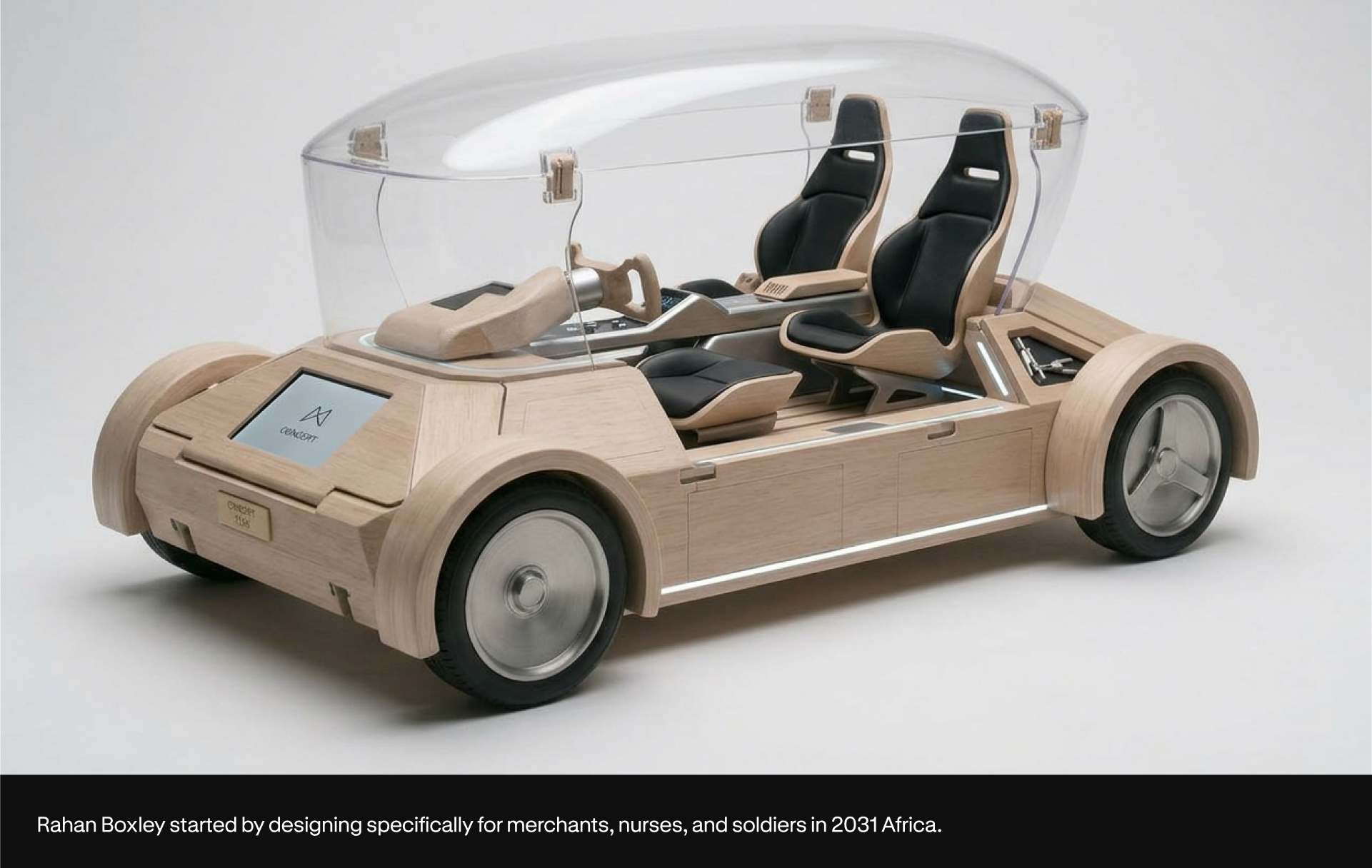
None of the participants simply opened an image model and typed "make me a car." Each designer approached the challenge through a completely different conceptual lens.
Henrik Svanvig focused on manufacturing systems and modular assembly logic. Rahan Boxley started from user personas and regional utility considerations. Erick Martinez approached the problem through abstract form exploration and sculptural visual language.
Despite using AI heavily throughout the process, each designer still followed recognizable design orthodoxy:
Research informed constraints. Constraints informed ideation. Ideation informed evaluation.
Although the tools changed, the underlying creative logic did not. Most importantly, the outputs diverged significantly because the designers themselves diverged significantly. The quality of the outcome was downstream from the quality of the thinking.

A lot of current discourse around AI design tools implicitly treats creativity as a prompting problem. Prompting does matter, but it isn't a magic incantation. The next creative breakthrough isn't hiding behind the perfect syntax that finally unlocks the machine.
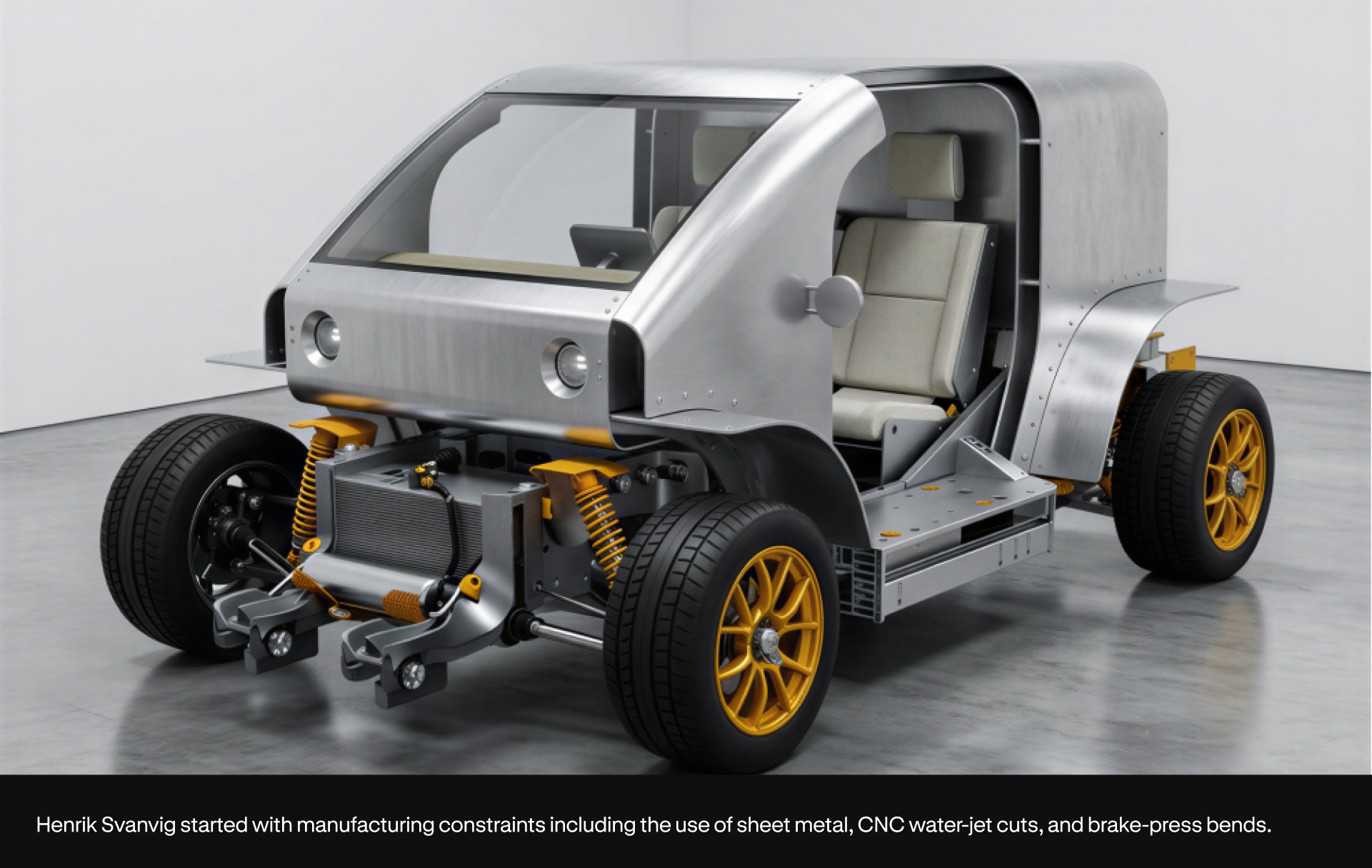
What our experiment suggested instead is that strong AI-assisted work emerges from strong creative direction, judgment, and conceptual clarity long before generation begins.
How does AI change creative workflow — and what stays the same?
One of the more interesting findings from the experiment was how AI compressed certain phases of the design process without eliminating them. This is where many conversations around AI become misleading.
There's a tendency to describe AI as replacing workflows altogether, but in practice it often actually redistributes effort within them. Used properly, AI makes creative effort more fungible. It allows designers to spend less time on production-heavy tasks and more time on areas where human judgment actually matters.
But that only works if teams understand which parts of the workflow benefit from acceleration and which parts still require deep human involvement. Leveraging AI strengths and intentionally combining them with human strengths is what separates a professional workflow from a merely fast workflow.
Every serious design project still moves through recognizable stages. AI simply changes the velocity and texture of those stages:
Problem definition > Research and synthesis > Ideation > Evaluation > Documentation
As AI-generated aesthetics normalize across industries, differentiation increasingly shifts upstream. The important question is no longer:
"Can your team produce polished work quickly?"
It's:
"Does your team know what's worth making in the first place?"
The real divide isn't technical
The teams getting the strongest results from AI right now are not necessarily the ones with the best prompts or the most advanced models.
They are the teams with:
– A clear design philosophy
– Strong editorial instincts
– Consistent evaluation frameworks
– The confidence to make intentional creative decisions
Technical access is rapidly equalizing. The tools are becoming cheaper, faster, and more widely available.
What remains scarce is perspective.
AI is extraordinarily good at producing plausible work. But plausible is not the same thing as meaningful. It is not the same thing as useful. And it is definitely not the same thing as original.
AI is an averaging machine. Without intentional steering, it will output beige nothing.
And that may ultimately be the biggest shift generative AI introduces into creative work: not the elimination of human taste, but the increased importance of it.
When everyone can generate almost anything, the people who matter most are the ones who know what's actually worth creating.