In 2007, a phone without a keyboard felt crazy.
For years, physical keys were the standard—tactile, predictable, familiar. The first iPhone replaced them with glass and asked people to believe it would feel intuitive.
Some embraced it immediately. Many hesitated, sticking to their Blackberries and sliders. Over time, we all came around. Tapping on a screen became effortless. Kids even learned to do it in school under their desks.
Emerging technology always follows this arc. Capability may exist from day one, yet trust develops through experience—through design choices that make new behavior feel credible and human. Yet, designers are often making it up. And in that ambiguity, they are negotiating trust in real time.
At Left Field Labs, we often find ourselves in this position—designing personalities for AI agents, embodied AI (think: robots), and even anthropomorphic phones. In 2026, there’s an added layer of complexity: the tech and news cycles move at extraordinary speed. What felt aligned yesterday might feel outdated tomorrow. Expectations shift just as quickly.
The question becomes: how do you design emerging tech in a way that earns trust from the very first encounter? Here are the principles we return to.
1. Designing without a playbook
Designing emerging technology often means building the thing and the rules for relating to it at the same time. Teams make decisions about interaction, presence, and tone before shared expectations take shape. Those choices define an experience and train people how to engage.
We felt this firsthand while building one of the first live embodied AI brand ambassadors, debuted at a major global event. The technology evolved as we worked. Capabilities shifted week to week. Public perception of AI shifted just as fast. The experience still needed to feel cohesive.
With few examples of AI-driven robots interacting live with audiences, we were designing the system and its social behavior at the same time. Part of that work meant training the robot’s movement through simulations in VR headsets, allowing us to test how posture, speed, and proximity would feel from the audience’s perspective before it ever reached the floor. We were shaping how it entered a space, how it “approached” someone, and how it invited interaction.
The new playbook:
Design social behavior as deliberately as technical behavior
Test early interactions as audience members. Notice hesitation. Notice curiosity. Notice distance
Assume early design choices teach people how to trust and relate to the technology moving forward
2. Designing for tech (and opinions) that are constantly in flux
How agencies approach experiential marketing has shifted dramatically, flexibility is now a primary design decision. People encounter emerging technology before they know what to do with it, what to trust, or how it fits into their world. In that environment, flexibility becomes a primary design decision. The experience has to keep pace as understanding, audiences, and context shift around it.
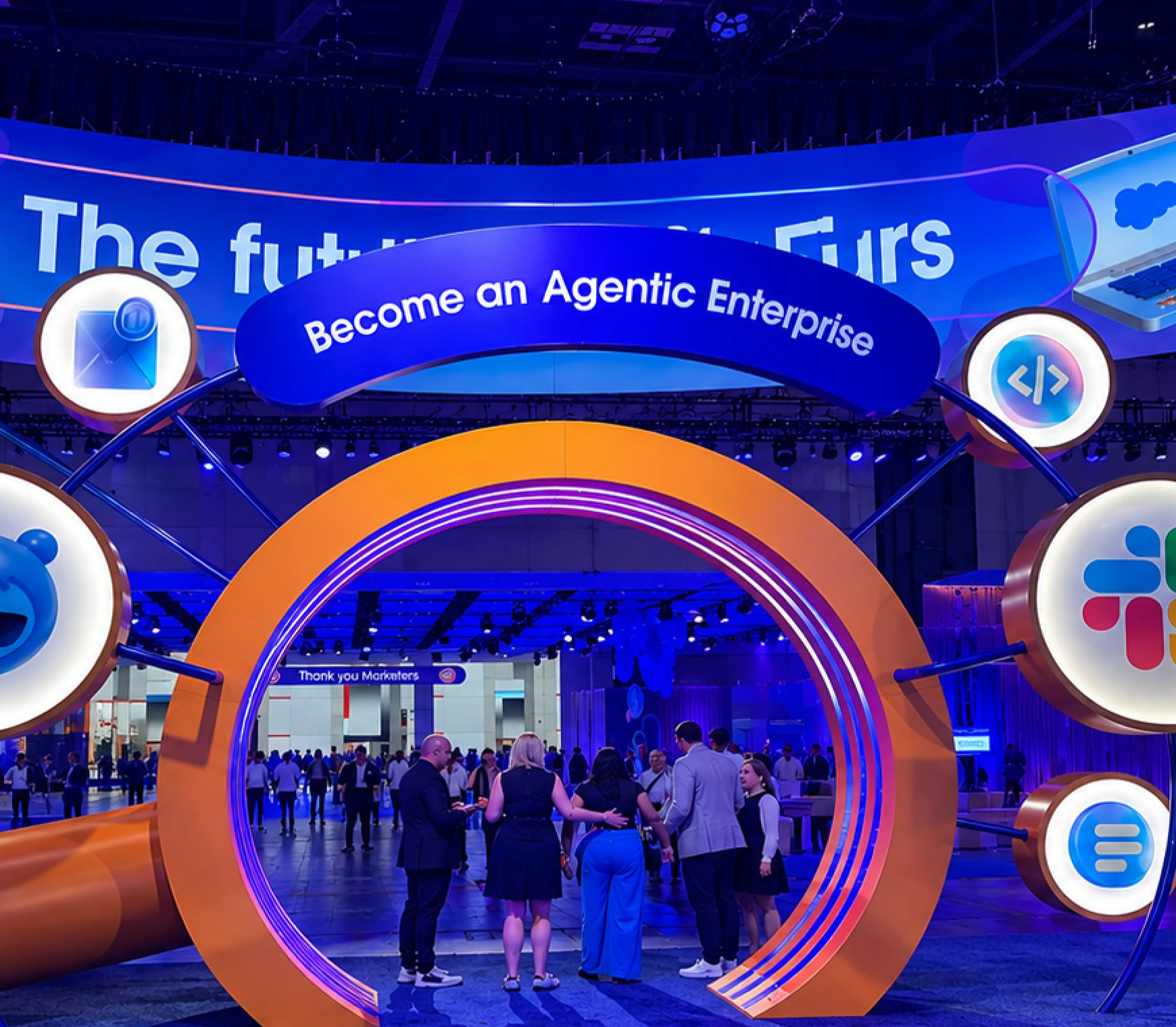
We approached the AI agents we built for Snapdragon Summit 2025 with this mindset. On stage, they appeared on screen alongside Qualcomm’s CEO and helped plan a party live in front of the audience. With public understanding of AI shifting quickly, we treated personality and visual cues as trust signals from the start, shaping how the agents showed up and how the interaction felt in the room. The core experience stayed reliable, and we built in clear points where tone, content, and pacing could adapt without requiring a full rebuild.
That separation—stable foundation, adaptable layers—allowed the experience to respond to context without losing coherence.
We’ve applied that same thinking in other activations. An AI-powered photobooth we built for Meta debuted with developers at LlamaCon, then appeared at the US Open, and later at UFC Fight Week. Same activation. Three wildly different crowds. While each adaptation successfully invited users to step into and interact directly with Llama AI, each audience ultimately got something different out of it—thanks to flexibility built in from day one.
The new playbook:
Anchor the core interaction so it remains reliable
Build adaptable layers around tone, narrative, and content
Create systems that can evolve without resetting the relationship with the audience
3. Designing first impressions that build trust
When emerging technology enters a room, trust (or the opposite) begins forming immediately. Long before someone engages directly, they are reading scale, posture, movement, tone, and responsiveness. They are looking for cues about intent and capability, deciding whether this system feels aware, collaborative, and thoughtfully designed.
With our robot, that accumulation of impressions mattered. Its physical presence drew attention, but attention alone does not create trust. What shaped belief was how it responded—how the screen shifted as someone approached, how the body adjusted its height, how pacing slowed during moments of interaction. The experience unfolded in layers, each one reinforcing the sense that the system was designed with intention.
People want to feel value directly. They want to understand why a piece of technology is present and what it enables. They respond to personalization that feels proportionate and respectful. They want to experience utility rather than hear about it. When systems perform live, adapt in real time, and make thoughtful use of data, confidence grows naturally.
Co-creation deepens that effect. In work like Best Phones Forever, audiences helped shape the narrative as it unfolded. Familiar characters established tone and context, and the system responded to fan ideas in near real time. That shared authorship created a different kind of relationship. Observers became contributors, and contribution strengthened trust.
The new playbook:
Earn confidence through intentional behavior at every stage of the interaction
Make utility visible so people can experience value firsthand
Use participation and co-creation to create shared ownership
4. Designing for value
While first impressions earn emotional trust, that trust must be supported by visible, measurable value. In the rush to adopt AI, organizations can move quickly toward implementation without fully articulating the gain. Everyone from consumers to boards are asking: What measurable value does this technology bring?
Audiences are asking their own version of the same question: What does this actually do, and why does it matter here? Businesses need answers to these questions. Better yet, make those answers visible inside the experience itself.
We saw this in Snapdragon City, an immersive activation designed to demonstrate Qualcomm’s technology in action. A 3D-printed miniature city sat on a glowing LED floor, surrounded by interactive journeys across automotive and mobile innovation. Custom language models answered questions in real time, and every element of the experience ran directly on Snapdragon hardware. This is how agencies build brands through experiential marketing, not by asking audiences to take a claim on faith, but by letting the technology demonstrate its own capability in real time.
We even built a visible window into the computer powering the activation so guests could watch the processing happen in real time. Instead of asking people to blindly accept a claim, we gave them a way to observe performance directly. The clarity of that proof gave the activation staying power—Snapdragon City returned to CES 2025, appeared on Jimmy Kimmel Live, and continued into future events because the value translated beyond a single moment.
The new playbook:
Choose the right technology for the right outcome, with a clear line between deployment and value
Let the technology demonstrate its own capability through real performance
Build transparency into the experience so belief is earned through visibility
Designing for belief
Emerging technology succeeds when people trust it. That trust is built through hundreds of deliberate decisions—about personality, transparency, pacing, proof, and value. Designers have an enormous opportunity to shape that with how we design a system to behave. Our take? Novelty alone doesn't drive consumers to accept new futures. They accept them because of how the future makes them feel.
The good news is that the experience sets the tone, and we get to design the experience.
If you’re introducing something new and want to ensure belief is built into the experience from the start, let’s talk.